

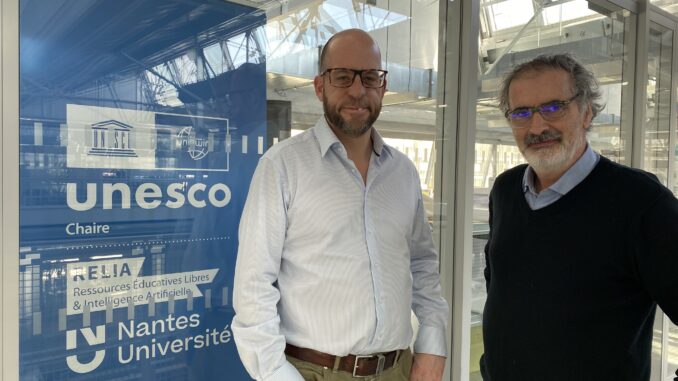
Cover image: Markus Deimann and Colin de la Higuera, Photo taken during Markus’s visit to the UNESCO RELIA Chair – Halle 6 Ouest, Nantes.
This article is a reprint of the article written by Markus Deimann, a German researcher in educational sciences at Ruhr University Bochum, specialising in educational technologies, open educational resources (OER) and digital pedagogical innovation. For over twenty years, he has been working at the intersection of education and digital technology, with a particular interest in open learning, artificial intelligence and the digital transformation of universities.
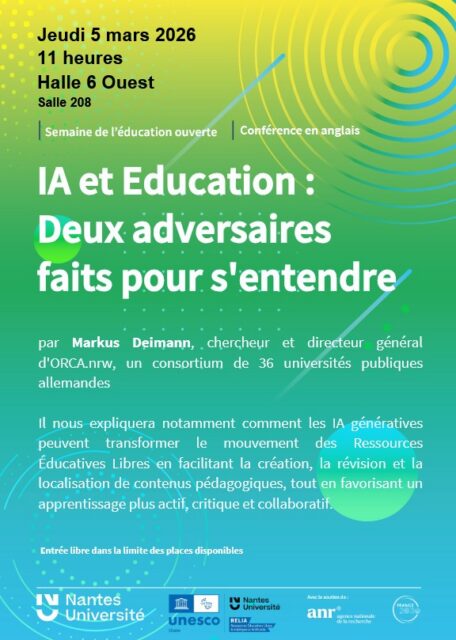
Markus Deimann visited Nantes Université in March 2026 during Open Education Week, which gave him the opportunity to learn about initiatives in Nantes and to share his research and projects with us. Let’s delve into his analysis.
Introduction: A Visit with a Purpose
As part of my job profile at the Open Resources Campus North-Rhine Westfalia (ORCA.nrw), I regularly try to connect with similar initiatives outside Germany. International conferences such as OEGlobal are one of the main ways for achieving this. Another way is through the Erasmus+ Mobility Agreement, which facilitates training and professional development opportunities for university staff in programme countries in order to promote internationalisation. In my case, based on a personal recommendation, I decided to visit Nantes Université as it is the host of the UNESCO Chair for Open Educational Resources (OER) and AI. Given the tremendous attention AI has received in all fields of education since the launch of ChatGPT in November 2022 and all the questions that have been posed regarding its relation to education and democracy in general and its impact on OER (flourish of cease to exist), the UNESCO chair seemed to be a perfect fit for me.
So, my goal was to get to know the different activities and projects happening at Nantes Université and the UNESCO chair. Basically, I tried to figure out how to deal with AI without falling into the trap of “wonder-panic” (Stash, 2024)1.
Open Education in France: Community, Creativity, and the Long Game
When I was in Nantes, I had a few meetings with colleagues from the UNESCO Chair and other related institutions. One of the meetings was with the Fabrique REL, whose mission is to raise awareness of Open Education and encourage different communities of practice to get involved. There are lots of activities which serve to show practitioners across the university that they are already following the ideals of Open Education, often without realising it. These faculty members could then be appointed ambassadors to work as change agents in a bottom-up way. This is different from the usual top-down approach, which tries to change teaching and learning activities using digital technology. With a top-down approach there is a general push to change things because students and employers expect it. However, the Fabrique REL looks at how teachers do their job every day and sees their teaching activities as the starting point for making improvements.

On the European level, the UNESCO Chair is also responsible for Open Education within EUniWell, a network of twelve universities. The central challenge of the network is to encourage participation on a voluntary basis, i.e., alongside other commitments.
It is a noteworthy approach to promote Open Education without the label “OER” but with the broader frame of “sharing” (see the series “Sharing is a challenge”.
In a similar vein, I observed the development of the “Fresque” workshop on Open Education, which is inspired by the format of a climate change awareness programme of the same name. The workshop is participatory, card-based, and designed for people who have never heard of OER. It moves through three phases: understanding why openness matters, practising the argument of convincing others, and identifying one concrete step each participant can take. It is, above all, a format for conversation rather than instruction.
In short, what these good practices have in common is that they all involve meeting people where they are, i.e. in their teaching spaces. This is essential for understanding the different contexts, the challenges, and the hurdles when it comes to Open Education.
Open Education in Germany: Infrastructure, Federalism, and the ‘Always Beta’ Problem
At first glance, the German OER landscape looks more institutionalised than the French one. There are dedicated portals, national networks, and a federal strategy with a budget attached. However, if you look more closely, you’ll see that it’s not as strong as it seems, which is something that people working in the field are well aware of.
As education is the sole responsibility of the “Bundesländer”, which have different resources and ambitions, a patchwork structure has emerged over the last 15 years. A newcomer, for example, is ORCA.nrw, a consortium of 36 public universities in North Rhine-Westphalia, which has been operating since 2021. It mixes technical infrastructure with human support, because it’s not just about having platforms, it’s about changing how things are done. Similar projects are running in eight of Germany’s sixteen federal states, each with its own funding and management, but all connected at a national level through a network to coordinate OER in higher education.
Community-building has been a real strength in Germany, with the OERcamp, an unconference format running since 2012, being the main gathering point for practitioners across higher education, schools and continuing education.
But there’s a recurring problem. Most of the OER infrastructure (in terms of both technology and society) relies on funding for specific projects, with no long-term policy commitments or a shared plan in place. The result is a landscape that looks good in theory but is a bit shaky in practice.
Only a few teachers have signed up so far. Legal uncertainty, lack of time, and the absence of institutional incentives are often mentioned as barriers. The challenge of reaching beyond the already-converted, the “ordinary” lecturer who’s never encountered OER, is as pressing in Germany as it is in France. That’s where the comparison gets really interesting.
Two Countries, One Challenge – and Some Productive Differences
After spending some time in Nantes and comparing the two systems, I’ve noticed that the differences aren’t as important as the similarities. In both France and Germany, Open Education is used by a small group of people who are really into it, but the funding is unreliable and it’s hard for advocates to reach more people. The project-logic problem, the difficulty of motivating “ordinary” lecturers, and the question of how to talk about openness without losing people in terminology are not national peculiarities. They’re basically just structural features of a field that’s grown a lot in ambition without actually getting any bigger in terms of institutional commitment.

France has come up with a whole host of new ways to get people involved. The Fresque workshop, the ambassador model of the Fabrique REL, and the deliberate reframing of OER as “sharing” all show a communication intelligence that the German field could learn from. Here at ORCA.nrw, we’ve made a similar shift, moving from “OER” to “digital educational content” on our public-facing platforms. But it looks like France is a bit further ahead in thinking through what that actually means in practice.
Germany, on the other hand, has infrastructure that France is still working towards. The OER network, OERcamp as a community format, and cross-state technical cooperation through shared repositories and OERSI (OER search index) provide a connective tissue.
This suggests that it’s not so much about one country being ahead of the others, but more about two systems developing strengths that go well together. That’s exactly why we should be exchanging ideas more.
Open Education Lives in Encounters
Visits like this one show why Open Education is a great idea. The experience is not what you’d find on a platform or a repository, but more like the kind of thing that happens when people with similar values and different experiences get together and swap stories. What I got out of my time in Nantes is a better idea of how France does Open Education, as well as a renewed sense that the work is worth doing and that it is being done carefully and creatively by colleagues who face the same problems as us.
- Stash. (24 novembre 2024). Alan Warburton Ponders the Wonder and Panic of Generative AI in8 New Documentary. ↩︎