


On 22nd and 23rd October, the European universities alliance EUniWell celebrated its 5th anniversary at the University of Cologne. In addition to cutting the birthday cake, the diverse programme included exciting lectures and inspiring exchange formats. One of these was the workshop “Opening up higher education: a pathway to well-being in teaching and learning”.
The exciting thing about it was that the participants explored the advantages of open educational resources (OER) with the help of a ‘board game’. And they had lots of discussions and fun in the process.
First, we will introduce the board game, then we will show the results. And finally, we invite you to play along: would your solution look the same?
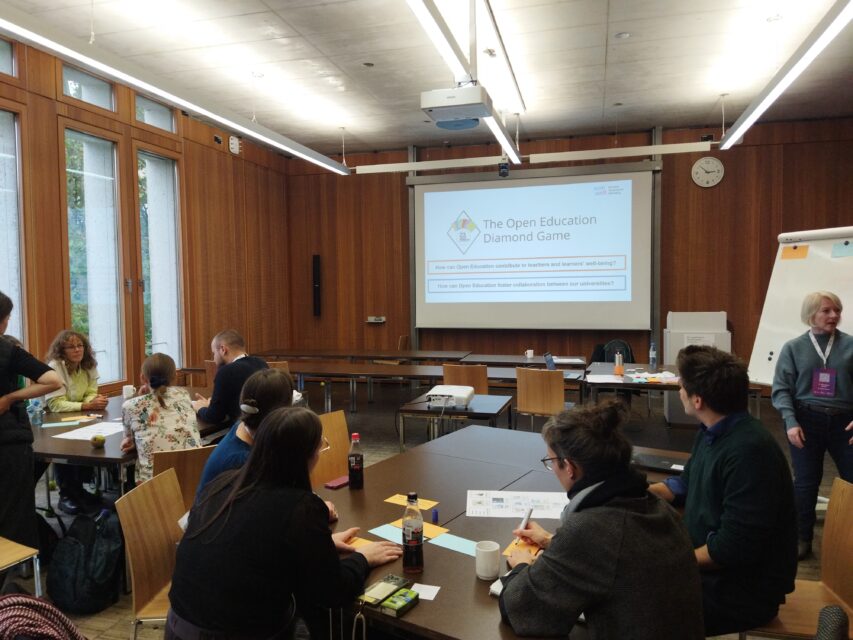
The Open Education Diamond board game
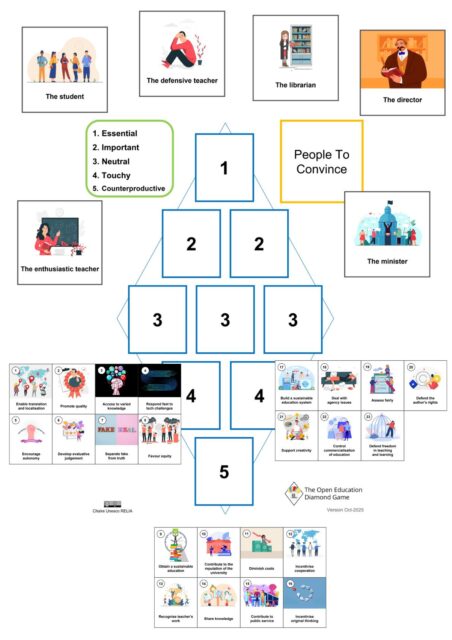
The game consists of a set of 23 cards, each representing a good reason to adopt open education, e.g. sharing knowledge, reducing costs, promoting collaboration, improving quality. These 23 good reasons for open education were described in detail in 23 blog articles published for the 2025 Open Education Week.
There are also 6 role cards, representing people who play an important role in higher education: students, teachers (one defensive and one enthusiastic), librarians, directors (e.g. institute or university) and (education) minister.
And, of course, the game includes a game board, with nine squares arranged in five rows in the shape of a diamond. Nine of the 23 reasons are to be distributed across these nine squares. Each of the five rows has a meaning, which is described on the game board:
- 1st row: essential
- 2nd: important
- 3rd: neutral
- 4th: touchy
- 5th: counterproductive
Finally, there is a square on the game board where role cards are to be placed.
The game is played by a group of 4-6 people and lasts approximately 30 minutes. The group first selects a role card that suits them and places it on the designated spot. Then, based on the 23 cards, participants must create an argument of 9 cards to convince the chosen person (the role) to adopt open education, ranking them from the most impactful (lines 1 and 2) to those that could be poorly received by the person (lines 4 and 5). This approach ensures lively discussions and debates, with the aim of reaching a common agreement on the ranking of the nine cards.
All game materials and a facilitation guide are freely available under a CC BY licence and in several languages, including English, on the UNESCO RELIA Chair blog.
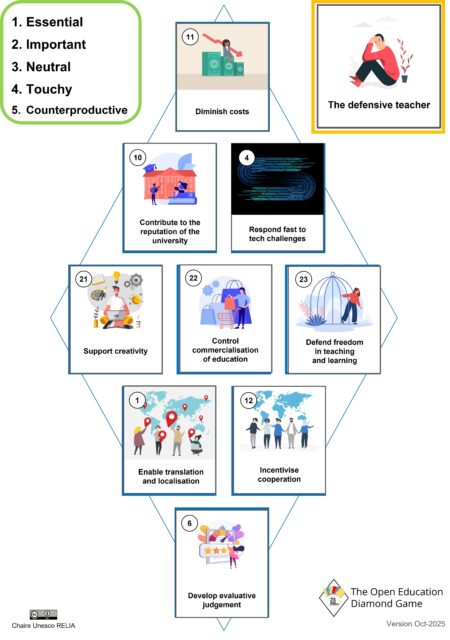
Results from our workshop
In our workshop, two groups took on this challenge. One group chose the role of the defensive teacher, the other the role of the head of the institution (university, school…). Both groups searched for reasons, discussed them, and assigned them with great enthusiasm and vigour. There was also a lot of laughter.
The results of the two groups are as follows:
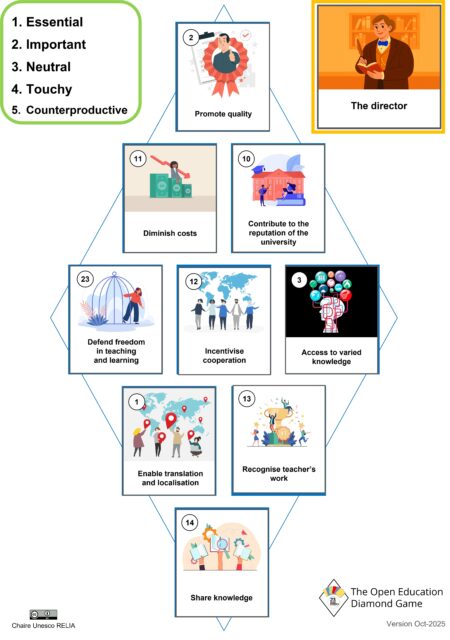
Open education, well-being and international cooperation
Alongside the board game, participants were also asked to answer the following questions:
- How can open education contribute to teachers and learners’ well-being?
- How can open education foster collaboration between the EUniWell universities?
The answers:
| How can open education contribute to teachers and learners’ well-being? | How can open education foster collaboration between the EUniWell universities? |
|---|---|
| Visibility; Less preparation; Teachers can be learners; Social justice (access); More choice of learning materials for learners; Offers more opportunities for dialogue; Time as an important resource for teachers; Merging more teaching and learning; Recognition and sharing = helping → happiness | Collaborative courses; Less language barriers (translation, multilingualism); Easy exchange; Matchmaking; Open education as a first step for a deep collaboration or co-creation; Interest in best practices; Incentivise funding |
The responses collected and discussions held during this workshop were very valuable. They help us, the Open Education Working Group, to understand how we can promote open education in EUniWell to address specific challenges faced, both as an alliance and in each of our universities. So, a big thank you to all the participants for their presence and their contributions!
Your solution?
Would you agree with the reasons given for the defensive teacher? And for the director? What role do you play and what reasons would be important or unimportant to you? What would you have answered to the two additional questions?
Feel free to send us your solution (euniwell[at]univ-nantes.fr), and, if you like, we can publish it here. If you would like to read more good reasons for open education, take a look at the 23 blog articles from the Open Education Week. We look forward to your comments!