Find below the list of articles from the “Sharing is a Challenge” series, published throughout March 2026 as part of Open Education Week.
“Sharing is a challenge” is a joint project between the UNESCO RELIA Chair, the UNITWIN-UNOE network and the European university EUniWell, following on from the series “23 good reasons for open education” published in March 2025.
This year, 30 authors from 15 countries have examined the obstacles to sharing, offering ideas on how to approach them differently and overcome them. In total, this series includes 16 obstacles, as well as an introduction and a conclusion.
All articles are available in at least English, French, and Spanish.
Happy reading!
And to find out more about what went on behind the scenes of this series and the authors’ experiences, listen to episode 97 of the OEG Voices podcast by OEGlobal, dedicated to ‘Sharing is a challenge’ (in English), hosted by Alan Levine, author of the article ‘Potential Serendipity over Expectations of Gratitude’, and co-author of the article ‘From judgement to sharing: rethinking teaching practices in the era of open education’. With Colin de la Higuera, coordinator of the ‘Sharing is a Challenge’ series, Lucie Grasset, editor for the UNESCO RELIA Chair blog, Virginia Rodés, co-author of the article ‘Between openness and responsibility: how to make good use of Open Educational Resources’, and Marcela Moralès, author of the article “Beyond Prestige: Whose Knowledge Counts in Open Education? – Legitimacy as a Barrier to Sharing”.
Every year in early March, open education is celebrated during OEWeek (Open Education Week), promoted by Open Education Global. This year, sharing is our common thread. We have identified 16 obstacles or challenges to sharing: some are real and may be related to a lack of technological or legal knowledge….
Sharing, education… Two very powerful words that naturally go hand in hand. What could be more fitting than asking a poet, an activist, a great educator to introduce us to the debates of this Open Education Week? Ahmed Galai, Nobel Peace Prize laureate in 2015, does us the great honor…
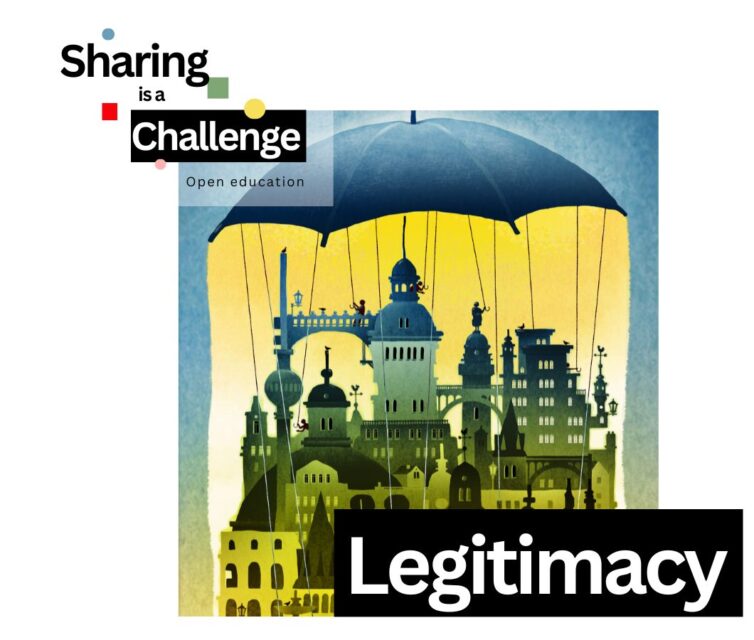
Am I legitimate in sharing? This question, which we all ask ourselves, is the starting point for the article by Marcela Morales (Mexico), co-executive director of Open Education Global. Her analysis and answer should reassure us…
Javiera Atenas and Leo Havemann (University of Suffolk and University College London, United Kingdom) note that while teacher-researchers readily agree to share the results of their research, the same is much less true when it comes to educational outcomes. Why does this difference exist? In their analysis, they also propose…
Mitja Jermol (Slovenia) and Fawzi Baroud (Lebanon) tackle a recent obstacle: do the successes of generative AI make OER obsolete? Starting from two very different perspectives, they come to similar and unexpected conclusions: producing open educational resources has never been more important!
Two articles chose the unhealthy relationship between Gollum, Tolkien’s fictional character, and his ring to illustrate the difficulty of sharing. Pierre Antoine Gourraud (Nantes Université, France) shares out of conviction. He is aware that science is built on people borrowing from each other and that participating in this science means…
This is a complicated subject in some countries. Is there, in certain forms of sharing, a more or less well-disguised colonialism? It is with great pleasure that we welcome Mpine Makoe (University of South Africa), Darrion Letendre and Robert Lawson (NorQuest College, Edmonton, Canada) to try to answer this delicate…
Must one be naive to share? That is the initial question that motivates the contribution of Dorothy Laubscher, from North-West University in South Africa. Her field experience in South Africa is put to good use: it is far away… and yet universal. And also, a beautiful enthusiasm that brings hope.
Latifa Chahbi, Loubna Terhaz, Khalid Berrada and Alan Levine (Morocco, USA) have created a new ad hoc team to tackle the issue of judgement. The analysis then shifts to North Africa, where OER have long been championed, and the global vision provided by Alan Levine. References abound, and experiences are…
Perhaps the most famous sharer of all time is Robin Hood. But he was also an outlaw. So it’s quite normal that we should all be concerned about sharing today. What is the reality? When do I have the right to share? And above all… what changes with AI? These…
Zoltan Lantos is a lecturer and researcher at Semmelweis University in Hungary. His story is one shared by many of his colleagues: it begins with a decision to share resources that initially seemed logical, then sees those resources gradually come to life, and ends with a sense of wonder at…
Barbara Class and Henrietta Carbonel from UniDistance Switzerland, and Mathilde Panes from the University of Teacher Education of the Canton of Vaud, rose to the challenge posed by the technical complexities of sharing. They succeeded in explaining to us why these technical issues are, above all, conceptual issues. And they…
Souhad Shlaka examines the issue of competition through the lens of her own experience as a lecturer and researcher at Mohammed V University (Morocco). The question raised was that of competition being imposed as a model of governance: how do we respond in order to replace it with a different…
Virginia Rodés and Regina Motz (both from Uruguay, although Virginia is now employed by the Institute for the Future of Education and lives and works in Spain) examine the potential misuse of OER. Their analysis, based on very recent findings, shows above all that simply sharing is not enough. For…
Are we sometimes expected to share? Is it sometimes counterproductive to force people to share? Answering these complex questions is the challenge taken up by Luc Massou (University of Lorraine, France), who draws on his experience at the French Ministry of Higher Education.
Discoverability… Now that’s a rather strange word. The starting point for our ‘discoverability’ challenge was the realisation that it’s very difficult to ask someone to share something if, for one reason or another, the course you’re sharing is hidden from view. In the so-called Global North, the challenge becomes doing…
A fine group of authors has come together to address this significant challenge: that producing OER takes too long. Sophie Depoterre, José-Miguel Escobar-Zuniga, Paul Lyonnaz and Nadia Villeneuve (Leuven, Belgium; Sherbrooke, Canada; Nantes, France; and Laval, Canada). Their conclusion is realistic: yes, it takes time to design an OER! But…
Alan Levine is one of the most active advocates in the open world. Every day, he manages to share online a website, an initiative or an idea that advances the open movement somewhere in the world. In this article, he draws on his own experiences to explain why it is…
As Open Education Month draws to a close, the series “Sharing is a Challenge” comes to an end. A huge thank you to everyone who made this possible — authors, translators, proofreaders and partners.The 14 male and 16 female authors from 15 countries have written 17 articles in 6 languages:…