

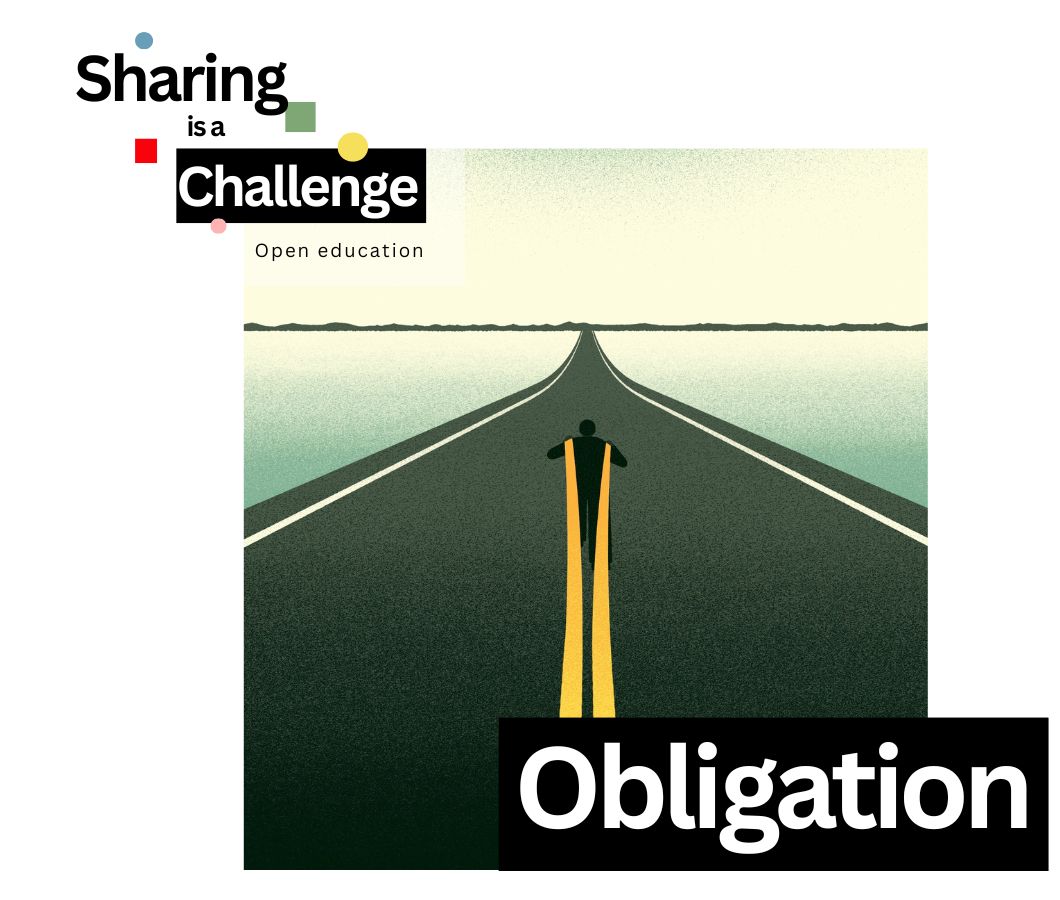
Featured image: “On The Road” by Andrius Banelis for Fine Acts remixed by the UNESCO RELIA Chair licensed under CC BY-NC-SA 4.0.
👤 Luc Massou is currently a scientific adviser at the Directorate-General for Higher Education and Professional Integration (DGESIP) at the French Ministry of Higher Education, Research and Space, where he is responsible for coordinating initiatives on open educational resources and open education for the Ministry’s 2023–2027 digital strategy, including ongoing work on the design of a national strategy for open education.
Some fellow teachers sometimes ask themselves: I am a civil servant, and my institution makes it clear that it is my duty to share my digital teaching resources, without necessarily being paid for it, even though it takes up a lot of my time. But is this really the case?
Taking the French context as an example, we offer several responses to these various assumptions here, and then outline four courses of action to transform a perceived obligation into a shared recognition of commitment to open education.
Is creating OER really an obligation (particularly for civil servant teachers)?
To answer this, let us take the example of higher education in France, as it leads us to qualify this first premise. In fact, this ‘obligation’ to create open educational resources (OER) is more closely linked to requirements set out in calls for proposals funded by public money to support pedagogical innovation through digital technology, much like what is required for publications from scientific projects also funded by public money. It may also be linked to an institution’s internal policy in favour of open education, but this scenario remains – for the time being! – still relatively uncommon to date.
In these publicly funded projects, the aim is thus to help produce educational resources that are shared – or shareable – well beyond the initial scope of the funded project, as part of a drive towards open access to knowledge. The term ‘digital commons’ is often used to describe these outputs, emphasising the importance of the widest and most diverse communities possible (academic, but not limited to!) being able to take ownership of and develop these OER over the long term.
However, these projects rely on authors (teachers or teacher-researchers in our example here) who volunteer to contribute to them. They are usually assisted by support staff (engineers or educational advisers, in particular) to design these OER. To summarise, the obligation we are discussing here is therefore largely determined in advance by the sponsor (and funder!) of these public projects, but does not fundamentally undermine the academic freedom of the authors who choose to participate… or not!
Is creating OER time-consuming and unpaid?
Yes and no. Designing an OER is indeed time-consuming, as it involves creating an educational resource for others, preferably with minimal contextualisation so that it can be easily adapted to educational contexts different from those of its original authors. One must therefore be able to put oneself in the shoes of other teachers or trainers, who will be potential re-users of this resource and who may also develop it further. This requires adherence to specific technical, legal and editorial constraints in order to make this OER modifiable, interoperable (i.e. independent of technical formats requiring specific software licences), inclusive and indexable (to facilitate its discovery via catalogues or search engines).
Producing an OER therefore requires support in the areas of educational design, digital technology and documentation, which is not always available depending on the schools or universities where the teacher-authors are based. Some countries, such as France, also co-fund national digital operators responsible for pooling these educational resources, who are thus tasked with disseminating and promoting them on a national and international scale via freely accessible online catalogues.
Finally, regarding authors’ remuneration, it is not systematically absent. It may be covered, most often in the form of overtime, by the publicly funded projects mentioned earlier, or through internal recognition schemes within institutions (such as bonuses for educational innovation). It may also rely on mechanisms to reduce teaching hours, thereby freeing up time to devote to creating these resources. Here again, these mechanisms depend heavily on the prevailing local and/or national contexts.
An additional task… or not?
In our view, the real fundamental debate is this: should the creation of OER be considered an ‘exceptional’ task, added on top of teaching duties, or is it already statutorily included in teachers’ duties? Let us again take the example of French higher education. The decree of June 1984 establishing the status of teacher-researchers is very clear: whereas scientific duties include the need to promote their findings and disseminate scientific and technical culture and information, the educational mission remains focused primarily on the transmission of knowledge through teaching.
The scientific aspect therefore fundamentally incorporates a ‘centrifugal’ dimension, that is to say, one that moves away from its centre in order to reach the widest possible audiences outside its own institution: a researcher publishes in order to give maximum visibility to their work, and thus allow knowledge to circulate freely. On the educational side, the dynamic seems – at first glance – to be rather the opposite; it is a more ‘centripetal’ mission that tends first and foremost to draw closer to its centre: teaching is geared towards meeting the internal training needs of the institution in which a teacher works.
This concrete example certainly explains why producing OERs for a potentially very broad audience (far beyond one’s home institution) is not necessarily self-evident and may be perceived as an additional workload by some teachers, whereas benefiting from the pooling of educational resources among teaching communities could save them time (particularly when preparing lessons) and also contribute to the wide and open dissemination of knowledge.
Transforming a perceived obligation into a recognised commitment to open education
As things stand, it therefore seems counterproductive to us to make the production of OER compulsory for teachers, as there is nothing in their terms of employment that actually obliges them to do so.
The challenge here is rather to provide them with better support to transform what is currently perceived as an obligation (or an additional workload) into a shared and recognised commitment based on common values that align, in particular, with the United Nations Sustainable Development Goal (SDG) number 4: “Ensure inclusive and equitable quality education and promote lifelong learning opportunities for all”.

How can this be achieved? Here are four possible courses of action, inspired by our current work to design a national strategy for open education in French higher education, with a view to gradually supporting this transformation in the medium term:
- Provide training in the principles, values and tools of open education from the outset of teacher training, and subsequently as part of their continuing professional development;
- Support and equip the creation of OER, to avoid asking teachers to do everything themselves. They need to be supported by specialised staff (in pedagogy, digital technology and documentation) on the technical tasks of engineering, media production, indexing and hosting/distribution of their educational materials. These tasks must be able to rely on digital working environments offering the appropriate tools to produce and distribute OER;
- Encourage teachers to collaborate in co-designing these OER as a group, as co-design has the potential to strengthen the collective ownership of a resource by a much wider user community, which must then be facilitated so that these resources become digital commons that will continue to evolve and circulate over time;
- Value and recognise the professional commitment of OER authors, whether they are teachers or support staff (such as educational engineers or librarians, for example). This institutional recognition can take several forms: recognition in career progression, bonuses, reduced teaching loads, awards… or inclusion in their terms of employment!
✍ The series of articles. This article is part of the series “Sharing is a challenge”, published throughout March 2026, in collaboration with the UNESCO RELIA Chair and the UNITWIN-UNOE network.
📧 Newsletter. To receive the upcoming articles from this series by mail, subscribe to our newsletter.
🖼️ Featured image. The original artistic intent remains that of the artist and may differ from the editorial intent of our remix. We thank Andrius Banelis for sharing their work on Fine Acts under the open licence CC BY-NC-SA 4.0.
🌐 Translation. This article has been written in French. This translation, produced using automatic tools and then proofread by our team, may contain inaccuracies. Please report any errors to us.
🅭🅯 Licence and reuse. Unless otherwise indicated, the content of this article is licensed under CC BY 4.0.