

Featured image: “It Is On Us” by Joana Mundana for Fine Acts remixed by the UNESCO RELIA Chair licensed under CC-BY-NC-SA 4.0.
👤 Fawzy Baroud. Associate Professor and UNESCO Chair in OER at Notre Dame University–Louaize, draws on more than three decades of experience in higher education IT to drive digital transformation initiatives. His work promotes openness and responsible innovation, with a strong focus on leveraging ICT and OER to expand educational access and advance equity.
👤 Mitja Jermol. Mitja Jermol is a Slovenian computer scientist and AI researcher, leading international initiatives on open education, knowledge technologies, and policy. He serves as a UNESCO Chair, shaping global discussions on artificial intelligence, ethics, and digital transformation across academia and industry.
Lebanon, Slovenia, 05.02.2026
Generative artificial intelligence (GenAI) is reshaping almost every established practice in education. Some argue that Open Educational Resources (OERs) are among the main casualties. GenAI can produce learning materials instantaneously and on demand, so what is the purpose of painstaking work of creating, curating, and sharing OERs? Why should anyone invest in commons based repositories when a simple prompt can result in comparable results in seconds?
OERs are mistakenly perceived as the content, something that could be easily synthesized by a language model. In reality OERs are designed learning experiences. They embody pedagogical intent to create learning experiences, include step-by-step process of understanding, involve activities that engage learners at various levels, provide feedback with assessments aligned with learning objectives and support inclusion through accessibility. All this human knowhow cannot (yet) be captured in a prompt even if it is complex and properly structured.
Beyond pedagogy, OERs also provide provenance and accountability, something GenAI struggles to. OERs allow tracing origins, which is essential for the educational context, where knowing where knowledge comes from is important not just to maintain academic integrity but also to allow others to build upon prior work.
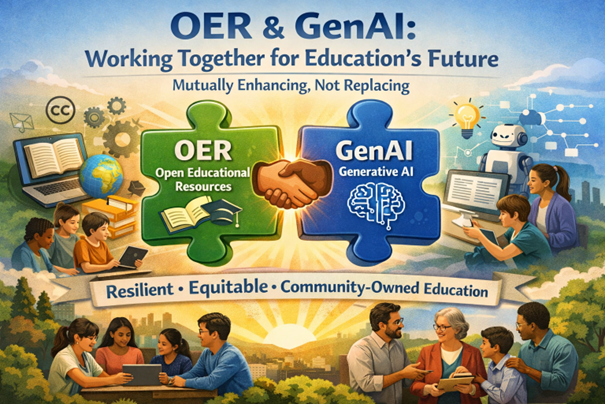
We should therefore look at the relationship between OERs and GenAI as a mutual enhancement, not a replacement. OERs provide transparent provenance, open licensing, and pedagogically designed learning experiences, while GenAI accelerates updating, translating, adapting and providing accessibility making OERs easier to maintain and more responsive without sacrificing quality or integrity.
In summary, this mutual enhancement can be viewed through specific dimensions:
- The training data paradox. GenAI are trained on human created content like OERs and if these are not there anymore, AI will be further trained on GenAI generated data that will lower the quality over time.
- Content against learning design. OERs are not just content; they include complex pedagogical architectures rooted in the centuries of expertise.
- Verification and trust. GenAI results lack origins. OERs carry attribution, can be peer-reviewed and follows scholarly traditions of verification.
- Contextualization and localization. In contrast to GenAI content that tends to be generic, OERs are able to capture specific linguistic and cultural contexts by communities that understand local needs.
- The commons. OERs represent education as a shared human undertaking. On demand generation by GenAI moves education away from maintaining knowledge as a common good.
And finally, the equity dimension. OERs are downloadable, accessible offline, and can be used without commercial APIs or subscriptions. How much this matters, however, depends entirely on the following:
OER and AI: A Global Question, Very Local Answers
The answer to the question about “Do we still need OER in the age of AI” depends a lot on where you are.
To illustrate this, we will look at two quite different contexts:
- Lebanon, where economic hardship and unequal access to technology make OER essential for fairness and survival.
- Slovenia, where strong digital infrastructure and European education policies shape how OER and AI are used in higher education.
By exploring these two cases side by side, we argue that the future of education is not about choosing OER or GenAI, but about understanding how they can work together in different realities.
The Lebanese Context
Lately, a bold idea keeps popping up in education discussions:
“Why bother with OER when AI can generate content instantly?”
On the surface, it sounds reasonable. With one prompt, AI can produce a lecture outline, a case study, or a quiz in seconds. So why spend time creating and sharing open resources?
Yet the practical limits of instant content become visible as soon as access, affordability, and language enter the picture. In Lebanon, this distinction really matters. Universities and schools deal with financial crises, limited budgets, and unequal access to technology. Not every student has a powerful device or access to paid AI tools. OER provides something crucial: free, reusable learning materials that can be translated into Arabic or French and adapted to real classroom needs.
Simultaneously, OER is not only a technical solution but also a social one, especially when users and institutions are under strain. OER also creates a sense of shared strength. When educators openly share resources, they support one another. Knowledge stays accessible, even when systems are fragile, and funding is uncertain. AI can absolutely help—by translating, updating, or personalizing OER—but it cannot replace the human values behind open education.
In Lebanon, OER remains a foundation for fair and sustainable education. The future isn’t about replacing OER with AI, but about using them together: OER plus AI.
Transition to the Slovenian Context
Lebanon shows how OER can be a lifeline during crisis and limited access. Slovenia, however, presents a quite different picture. With strong digital infrastructure and support from European education policies, the focus is less on access and more on questions of innovation, academic integrity, and long-term sustainability.
Since Slovenia offers universal internet connectivity and strategically supports educational institutions with investments, the general barriers to adopting innovative technologies and/or practices like GenAI are lower. The main challenge Slovenian educational system faces is not whether students and teachers will be using GenAI but how. This brings opportunities but also tensions in an area where established practices and guidelines are still lacking. Several drawbacks have been already reported, like, for example, the absence on critical assessment of AI generated content, homogenization of materials, intellectual property and licensing issues, a skill gap and increased workload.
Slovenia, Europe and most of the world is facing a critical challenge of being reliant on a few powerful GenAI frameworks controlled by global tech giants. This threatens digital sovereignty and educational autonomy, as shifting geopolitics could make today’s tools unaffordable tomorrow. Despite investing in a national language model, Slovenia alone cannot compete with corporate scale, making long-term independence a pressing issue.
Bridging the two perspectives
Taken together, these two contexts show why the mentioned dimensions like equity, trust, localization, and commons play out differently depending on local conditions. When we look at Lebanon and Slovenia together, we see how the same global debate takes quite different forms. In one context, OER supports equity and resilience during crisis. In another, it complements advanced digital systems. What stays constant across both cases are the core values of openness, collaboration, and inclusion.
Dependency is the risk; diversification is the strategy
Discussions on both sides are also about whether we should treat GenAI not only as tool but as the main infrastructure for education. That raises critical risks of dependency to a small number of platforms, their pricing models, connectivity conditions and policy decisions that educators and learners cannot control. Here, OER can bring in necessary resilience by providing a stable, offline, auditable layer, while using multiple, replaceable GenAI tools as an enhancement layer that can be switched or turned off without breaking education.
Owning our educational future
“Do we still need OER in the age of AI?” is not the right question. We should ask ourselves, “Who do we want to control the future of education?” instead.
Relying solely on GenAI would mean to run education on a rented land. As the examples of Lebanon and Slovenia show, being dependent on a few commercial GenAI models leaves education vulnerable to rising costs, technical difficulties and policy changes that we cannot control.
A potential path forward is to use both, enhancing each other’s specifics. OER as foundation can ensure that knowledge remains free, verified by humans and always available to everyone without restrictions. GenAI as accelerator can provide easy, effective and powerful mechanisms to translate, adapt, and update that foundation.
By assuring the education remains open, owned and operated by community, while using GenAI to empower it, we can ensure that learning remains a public good rather than a private offering. This is how we build tomorrow’s education that is not just high tech, but social, ethical, safe, and open to all.
✍ The series of articles. This article is part of the series “Sharing is a challenge”, published throughout March 2026, in collaboration with the UNESCO RELIA Chair and the UNITWIN-UNOE network.
📧 Newsletter. To receive the upcoming articles from this series by mail, subscribe to our newsletter.
🖼️ Featured image. The original artistic intent remains that of the artist and may differ from the editorial intent of our remix. We thank Joana Mundana for sharing their work on Fine Acts under the open licence CC BY-NC-SA 4.0.
🅭🅯 Licence and reuse. Unless otherwise indicated, the content of this article is licensed under CC BY 4.0.