

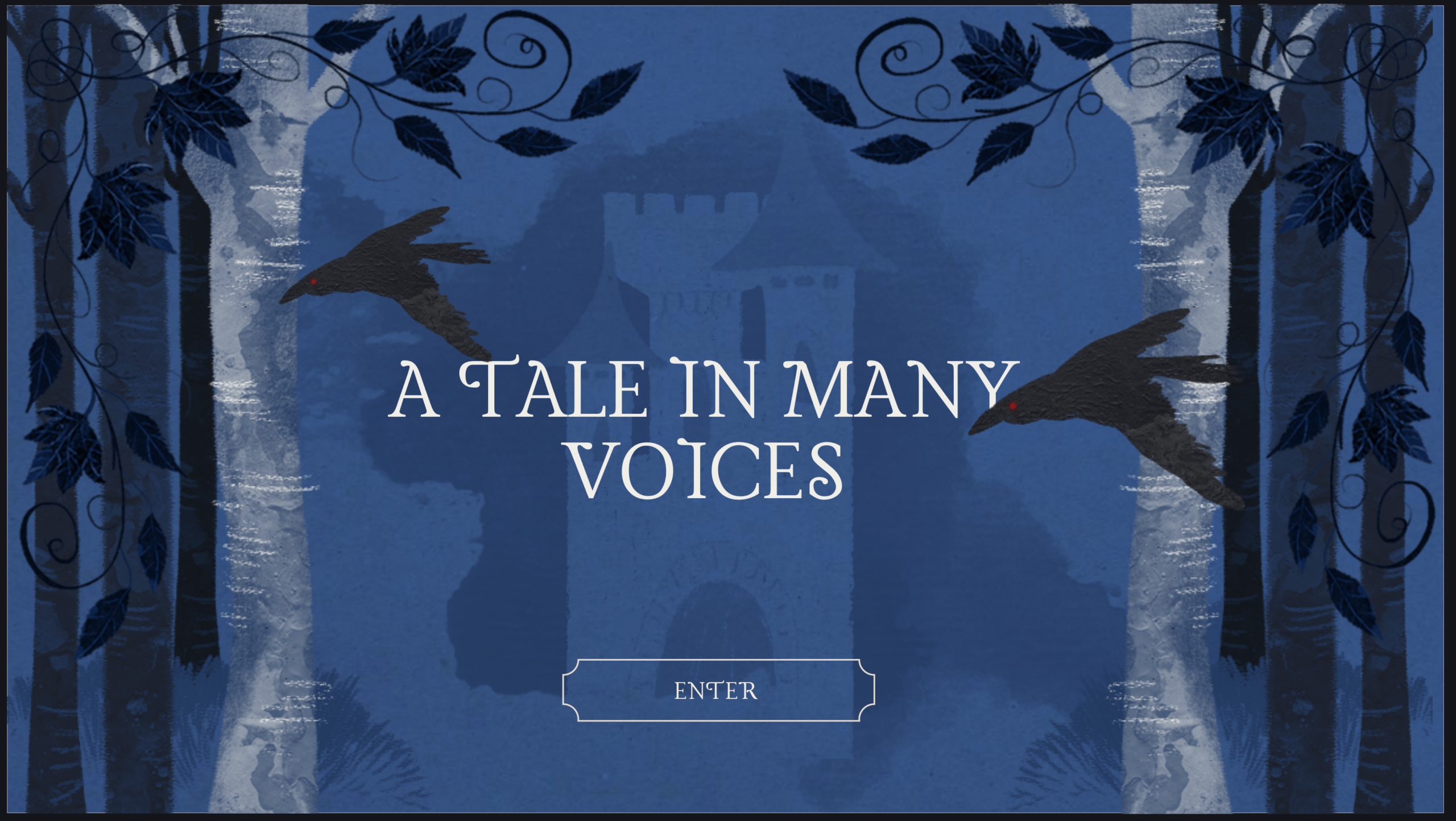
Featured image: Startpage of “A Tale in Many Voices” by Snejana Gadjeva and Ildikó Lőrinszky on Inalco Moodle+.
A Tale in Many Voices grew from a simple but ambitious idea: to find a text short enough to translate into dozens of languages, yet rich enough to spark literary and pedagogical works. Fairy tales — universal, timeless, and culturally resonant — were the obvious choice. Among Perrault’s tales, The Fairies (1679) stood out: the shortest in his collection, less well known than Cinderella or Puss in Boots, yet carrying a message that transcends cultures — the quiet power of kindness. In its latest version, developed as part of the EUniWell alliance, learners will have access to the same fairy tale in 20 languages, both European and non-European. You will discover how each translator’s choices — of words, tone, and style — reveal something unique about their language and literary tradition.
Ildikó Lőrinszky is a lecturer of Hungarian at Ankara University and Literary Translator, and Snejana Gadjeva is a senior lecturer of Bulgarian Language and Linguistics, and Contact Linguistics at Inalco. They worked together as main authors and editors of the project. They also created the resources for Hungarian (Ildikó) and Bulgarian (Snejana). The interview was conducted by Roxane Poor-Hang, learning designer at Inalco, involved in the creation of this module, and Inalco’s representative within the EUniWell working group.
Can you describe the resource that you initiated?
The page A tale in many voices, available on the Moodle+ platform of Inalco, presents one component of the project Les voix du conte, initiated by Ildikó Lőrinszky within the research activities of the PLIDAM laboratory at Inalco.
The initial idea was to translate Charles Perrault’s tale Les Fées (1697) into several languages. The project was later opened to collaboration with faculty members from other research teams of Inalco and other universities inside and outside of France.
The choice of the format of the module was decided after discussion with Boriana Silhol and Sophie Briquet, two of the learning designers in charge of the digital resources at Inalco. They suggested creating an open-access page on the Moodle+ platform, accessible not only to Inalco students but also to external audiences. Our aim was to reach students interested in discovering languages beyond their main field of study, as well as a broader audience of language enthusiasts.
What was your initial intention?
The module was initially created in French and it included around fifteen languages. From the beginning, we intended it to work as an open language learning resource.
Our goal was to reach a wide and diverse audience, both within and beyond Inalco. The collaborative and multilingual nature of the project reflects the spirit of Inalco: a unique place in France and in the world where more than 100 languages are taught. Some of these are widely spoken globally, while others are used by smaller communities.
Inalco brings together students from different countries, with varied motivations and heterogeneous language backgrounds. Many of them are complete beginners, while others have prior knowledge or are heritage language speakers or native speakers.
In academic contexts, languages are sometimes informally classified as “large languages” those with many students in the courses, and “small languages” those with few students. One of our key intentions was to move beyond this distinction by bringing together different languages in a shared space. As a result, users will encounter in the module languages such as Chinese and Turkish alongside Hungarian and Bulgarian. Now, the project also includes languages such as English, German, Italian, as well as few languages spoken in Chad. And it stays open to further expansion.
What methodology did you follow?
The first step in developing the resource was to publish the translations from French into each language on the Traduxio platform. Colleagues who wished to take the project further then recorded audio versions of the translations. They were subsequently integrated into the Moodle+ page.
We also aimed to provide users with opportunities for autonomous learning. To this end, we developed a model based on three types of interactive exercises, each accompanied by clear and simple instructions.
One set of exercises focuses on oral and written comprehension of the tale; another addresses selected grammatical features; and a third explores key vocabulary.
This model was shared with collaborators, who were invited to adapt it to the specific features of their languages. Every collaborator was also encouraged to include a short presentation of the language and links to additional resources, allowing users to extend their learning experience.
How did the collaboration work in practice?
The initial exercise templates were developed with the help of Boriana Silhol, the learning designer in charge of the French version of the module. Each collaborator then adapted the different sets of exercises within the Moodle+ section dedicated to each language.
A colleague from the Educational Technology Department (TICE), Thierry Djikine who is a sound engineer, recorded several of the audio versions, while the documentalists, Raphaëlle Hervé and Christine Ho, identified suitable royalty-free images. Learning designers provided ongoing support, helping collaborators integrate the materials on the Moodle+ page and resolve technical issues, including those related to different writing systems and keyboards. Roxane Poor-Hang from the learning designers’ team took care of the entire adaptation of the materials from the French to the English version of the module.
Did the open-access dimension influence your choices?
Yes, the open nature of the resource led us to be particularly attentive to the selection of images, icons, and textual materials, ensuring full respect of copyright and usage rights.
What were the main challenges?
One of the main challenges was encouraging collaborators to work directly within the Moodle+ platform. Despite the availability of a flexible model and several training sessions, some contributors found it difficult to independently adapt or recreate the exercises for their languages.
How has the project been received so far?
At this stage, we have received feedback only on the original French version of the page. As the English version represents a new phase of the project, feedback is still limited.
The platform is designed to be explored by users with different levels of language proficiency, offering opportunities to discover new languages and broaden their interests. We warmly welcome future feedback from users and collaborators.
Note: “A Tale in Many Voices” is listed on EUniWell’s course catalogue, and available on Inalco Moodle+. Access requires an account, which is free and open to everyone. To create one, please follow the guide below.