

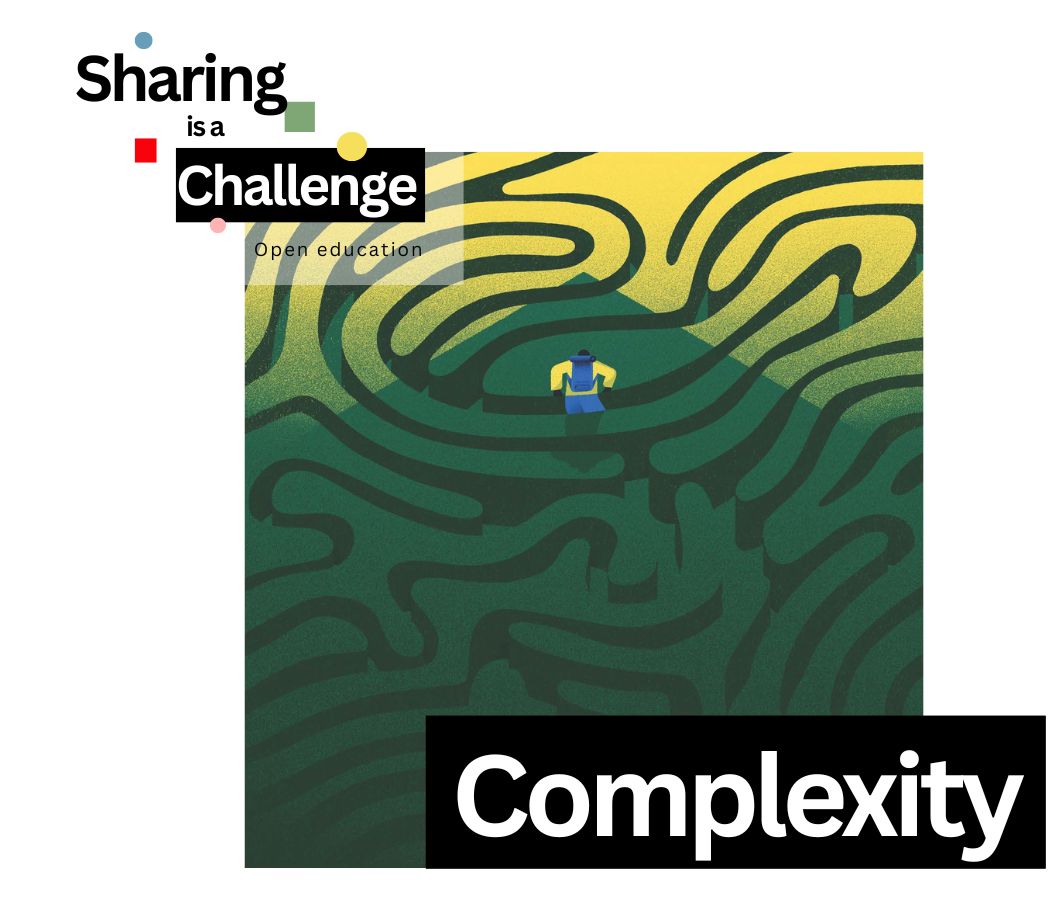
Featured image: “It’s Darkest Before The Dawn” by Andrius Banelis for Fine Acts remixed by the UNESCO RELIA Chair licensed under CC-BY-NC-SA 4.0.
👤 Barbara Class has been in educational technologies for 25 years and contributes to advance the field of Open Education. She currently works at UniDistance Suisse on assessment in Open Education. Her profile page.
👤 Mathilde Panes. Based at the University of Teacher Education, State of Vaud, Mathilde Panes leads Open Science initiatives with a focus on open educational resources (OER). Over three years, she has worked to promote OER among university lecturers. She holds degrees in Information Science and Business Administration, and a CAS in Data Stewardship.
👤 Henrietta Carbonel, PhD, is an instructional designer in the Educational Development Unit in Distance Learning (EDUDL+) at UniDistance Suisse. Henrietta supports faculty in developing their pedagogical skills and in designing distance learning modules. Her research focuses on digital technologies in higher education, including the university of the future, the use of AI in learning, and remote assessment. She is particularly interested in speculative methods as tools to anticipate and critically examine possible educational futures.
“I can’t open your file”, “the font is all over the place”, “this software is not available at my institution”, “which software shall we use to collaborate?”.
We have all been there. Sharing openly is not just a mindset, it is a set of practices, tools and workflows. Formats break, platforms lock you in and licences raise questions at every turn. Let’s explore what makes sharing feel complex and how to navigate it with some freedom.
A challenge is defined in English as a difficult task or problem potentially providing enjoyable intellectual stimulation. In French, the definition underlines the objective: why do you want to take on this challenge? It is therefore essential to identify the objective, i.e. the purpose of sharing.
Do we share in order to create knowledge together? Do we share to make ourselves visible? Do we share to provide access?
These few examples show how essential it is, first and foremost, to understand where we stand in the culture of sharing. The key is to identify the why.
Next comes the question of how to share. Is sharing conceived upfront as an overall structuring principle? Is it used upfront to orient the pedagogical design? Is sharing rather a later decision once the output has already been created?
Finally, comes the what. What are you going to share? The (co-)creation process? The output? A README file? The aim is to identify the how and what(see The Golden Circle by Simon Simek) in terms of micro-societal organisation, with its values and rules (see for example Bollier, D. (2024). Challenges in Expanding the Commonsverse. International Journal of the Commons).
These questions, which are directly related to pedagogical design, are already complex and involve entangled elements. They become even more complex when legal, economic or technical dimensions are added, as illustrated below.
From good intentions to real world constraints
Behind the concept of open educational resources (OERs) lie convictions, intentions, and complexity. To move from a conviction to sharing one’s own productions as OERs, one must navigate this complexity, either alone or with support.
From finding material to reusing, transforming and publishing it, an OER enthusiast will face a lot of uncertainties. For example, simply discovering an OER is a multi-step process: defining your needs; searching across multiple repositories (if the resource is even stored in one); and evaluating the resource’s quality and fit for purpose, including both the accuracy of its content and the soundness of its pedagogy. As a side note, AI can be very helpful here to help you identify where to find relevant OERs.
Once you have found an OER, you will probably need to transform it. This means understanding what you are allowed to do or not. Creative Commons (CC) or Traditional Knowledge (TK) licenses are particularly useful here, if you know what the different CC or TK licenses mean.
The topic of artificial intelligence is also adding to the complexity of OER creation: a new fear might arise “will my content be unfairly used by AI?”. Uncertainty is high.
Moreover, underlying all these steps is the technological challenge.
Literacy to break free from specific technology, tools and formats?
Openness is about redesigning power relations at the pedagogical level to co-create knowledge among a community of engaged stakeholders; it is also about redefining knowledge as a commons; furthermore, it is about transforming the governance of knowledge and technology. In practical terms, openness is closely tied to technological issues. Indeed, the choice of a given technology comes with its own set of constraints and freedoms. Creating an OER involves several steps: content, pedagogy, design, copyright/attribution, publication, and each step comes with technology and tools. That is where friction appears: files that only open in one software, layouts that break elsewhere, missing fonts, paywalled platforms, “not available at my institution or for citizens more generally”. The resource may be shareable on paper and digitally in pdf format, but not usable in practice.
Moreover, institutions often push “safe” tools that are supported internally, stable and integrated. The downside: users are locked in. OER creators thus have the responsibility to strike a balance between tools and formats that are commonly known and used, and others that are more open, portable and editable. This can lead to uncertainty and extra workload because contributors need to be literate in the use of a large set of technologies, tools, formats, and potential conversion tricks. Technical issues feel overwhelming because they add up and seem to affect the form when one wants to focus on the substance and create. But technology does affect the substance, increasing the responsibility of the creator and subsequent users. The choice of platform, format, or template today can create problems later down the line. The ideal of sharing can rapidly become a burden.
Fostering openness through support
Complexity is not a reason to quit. It is a challenge to overcome and a reason to provide a supportive ecosystem around OERs and Open Education more generally. Literacy – not to say fluency – with technology takes time to experience. It comes step by step, by learning which decisions make co-creation and reuse easier and by pooling and sharing this information. So, nothing better than a sandbox to become OER-savvy from the technological perspective.
Support can be technical, such as formats, exports, and accessibility checks. It can be editorial, such as structuring a resource for reuse. It can be legal, such as licence compatibility and third-party content. And, crucially, it has to be social. Knowing who to ask, having a community that shares templates and tips, and learning from real examples turns trial and error into a shared practice.
This is also where the “purity” trap shows up. It is tempting to think “open versus closed” or “open versus broken”, as if you need a perfectly open workflow from start to finish. Thinking about openness in a continuum is more productive. An orientation towards Openness through sharing in multiple formats or providing an editable version alongside a stable one, is more valuable than chasing an ideal and publishing nothing. The point is to leverage and enable as much as possible for anyone who wishes to act on this resource.
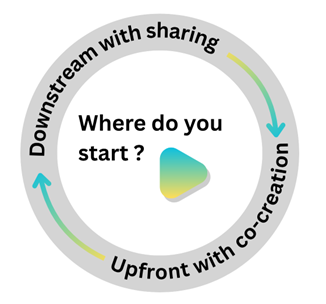
Recommendations for practical reduction of complexity
- Publish in pairs: one “easy to read” format (PDF/HTML) plus one or two “easy to edit” source files (for instance, Markdown files, but also DOCX and ODT, PPTX and ODP, etc.).
- Choose portable formats early on: avoid tool-specific features that do not survive export (exotic fonts, heavy animations, embedded proprietary widgets)
- Document the basics: include a short “How to reuse/edit” note (tools needed, where source files are, licences, attribution, etc.)
- Prefer “good enough” openness over no co-creation and/or no sharing at all: partial openness and clear documentation beats an ideal OER that is never enacted
How can we overcome the challenges of complexity when it comes to sharing and creating a commons?
At the personal level, set aside all forms of fear (fear of being judged by a colleague, fear of how time-consuming sharing can be, fear to change, etc.) and trust your professional practices, always doing the best you can, being aware that mistakes are possible and can also be corrected. “Exposure” should not be seen as a risk but as a way to grow and improve your expertise through the constructive feedback of others.
At the organisational level, adopt a caring systemic approach that prioritises the commons and collective coexistence. Sharing then becomes a structuring principle.
At the pedagogical level, choose learning theories oriented toward sharing. For example, the theory of situated and distributed learning developed in the 1970-1990s (see the work of David Perkins) which conceptualizes the person-solo and person-plus competencies. The latter refers to the capability to draw on both internal and external resources such as communities of practice and/or technologies.
At the technological level, use free software as much as possible: sharing is in their DNA and beyond the possibility for any citizen to access them, their adoption is also about reclaiming a form of democracy. Free software is experiencing renewed momentum, so it is the right time to join a community of practice and change (see, for example, the Framasoft community)!
Ultimately, sharing is much simpler than we think: just think differently as Bawden (1991) said: “It is so much easier, and thus pervasive, to deal with unfamiliar issues in a familiar way than it is to deal with familiar issues in an unfamiliar way”.
✍ The series of articles. This article is part of the series “Sharing is a challenge”, published throughout March 2026, in collaboration with the UNESCO RELIA Chair and the UNITWIN-UNOE network.
📧 Newsletter. To receive the upcoming articles from this series by mail, subscribe to our newsletter.
🖼️ Featured image. The original artistic intent remains that of the artist and may differ from the editorial intent of our remix. We thank Andrius Banelis for sharing their work on Fine Acts under the open licence CC BY-NC-SA 4.0.
🅭🅯 Licence and reuse. Unless otherwise indicated, the content of this article is licensed under CC BY 4.0.