

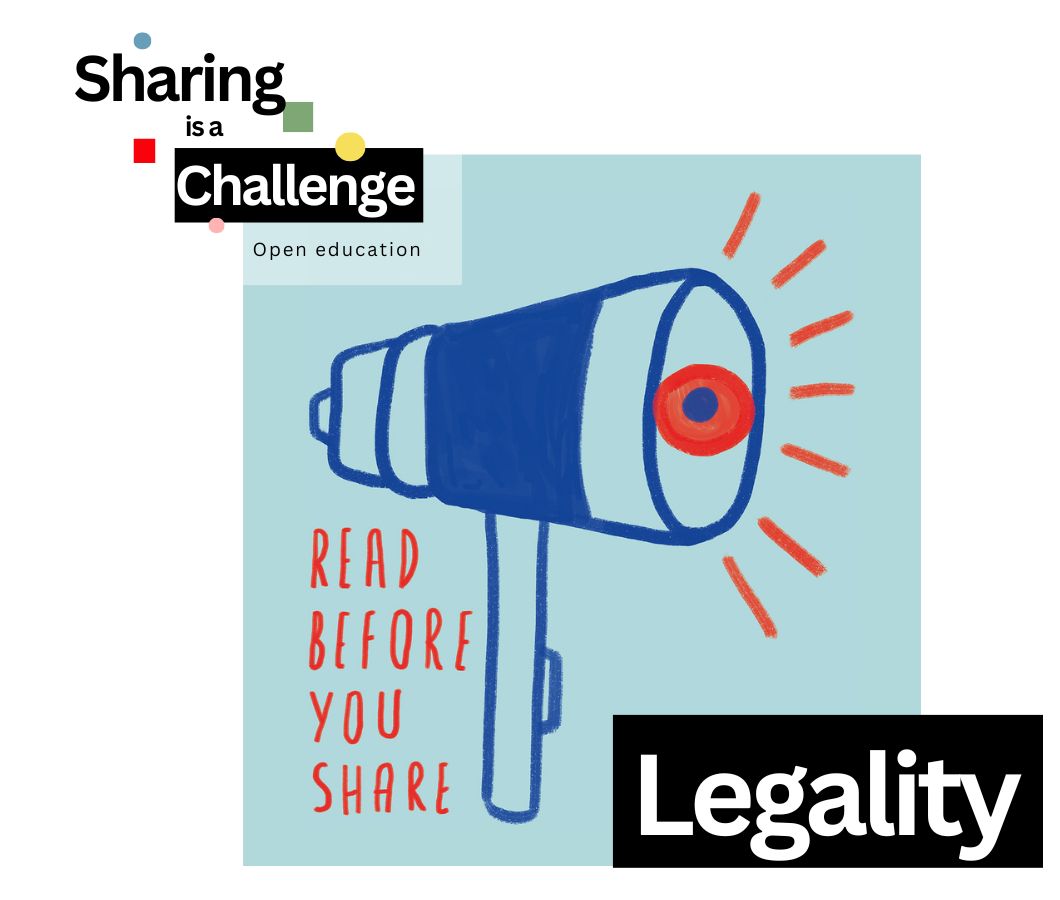
Featured image: “Read Before You Share” by Daniela Yankova (Shadowschaser) for Fine Acts remixed by the UNESCO RELIA Chair licensed under CC-BY-NC-SA 4.0.
👤 Rory McGreal is the UNESCO/International Council for Open and Distance Education Chair in Open Educational Resources (OER) at Athabasca University, Canada. He is Editor of IRRODL, the highest ranked open access journal in EdTech. He is also founder of the OER Knowledge Cloud, a repository of articles on OER. He is the recipient of several international awards and has presented at conferences in more than 60 countries.
Introduction
The rapid emergence of Generative Artificial Intelligence (GenAI) has ignited profound legal and ethical debates within open and online education. At the heart of these debates lies a critical question: who owns AI-generated content, and is it protected by copyright? For educators and content developers, GenAI presents both a remarkable opportunity and a significant source of anxiety. It offers access to a vast commons of digital material for inspiration and use, yet many feel they are navigating a legal minefield without guidance. This uncertainty stifles collaboration and sharing, primarily due to two paralyzing concerns:
1. The Paralysis of Legal Uncertainty. The core issue is not a reluctance to share, but a fundamental lack of accessible legal understanding. Complex copyright laws and nuanced licensing terms are often perceived as an exclusive legal language. This fosters a climate of fear, where educators are less concerned with how to share responsibly and more preoccupied with the dread of making a costly legal mistake. In short, educators want to participate but are terrified of the “what if.”
2. The Crisis of Trust in Shared Content. Compounding this fear is a growing awareness of contaminated sources. The widespread problem of copyrighted material being improperly repackaged and relicensed as “free” erodes confidence in the entire sharing ecosystem. If the license attached to a work cannot be trusted, how can it be used safely? This leads to the debilitating question: “In my effort to do the right thing by using shared material, am I actually exposing myself to undue risk?”
This article confronts these intertwined problems directly. We move beyond generic advice to address the specific apprehensions that hinder creators. Our goal is to demystify the legal landscape, provide current information on using shared material, and rebuild the confidence needed to engage with the digital commons—not recklessly, but with informed and empowered knowledge.
Presently, a clear legal trend is emerging that strongly supports openness in education. The evolving copyright landscape for GenAI, characterized by the denial of protection for purely AI-generated works, aligns with fair use/dealing doctrines and statutory exceptions for education. This creates a novel and powerful foundation for a new class of fully accessible Open Educational Resources (OER), democratizing content creation and freeing it from traditional copyright restrictions.
The Legal Landscape: Denials of Copyright Protection for AI Content
A consensus has solidified in key jurisdictions: copyright protection is denied to works generated solely by AI, as copyright requires a human author. In the United States, the Copyright Office and federal courts have consistently held that works created “without any creative input or intervention from a human author” are ineligible for copyright, a stance affirmed in the Thaler v. Perlmutter court decision. Similarly, the Beijing Internet Court and the European Union in the AI Act have ruled that AI lacks the legal personhood for authorship. Therefore, exclusively AI-generated content resides in the public domain and can be freely used without copyright restrictions. As of 2026, no major jurisdiction recognizes an autonomous AI system as a legal author or copyright owner.
Human-AI Collaboration: The Grey Zone
Ambiguity arises when humans collaborate with AI. Courts are assessing the degree of human “intellectual input, creativity, or interactivity” required for copyright to vest. Guidance suggests that if a human is substantively involved through prompt selection, iterative refinement, or substantive editing, they may be considered the author. The U.S. Copyright Office evaluates such cases on a continuum. For educators, this means that when they significantly edit, refine, or localize GenAI content, they can claim authorship and should apply an open license (e.g., Creative Commons) to the resulting OER.
Substantial Contribution or Statutory Exceptions
In Common Law countries (e.g., UK, USA), copyright infringement requires the taking of a substantial part of a protected work. Insignificant copying is not infringement, and such content is effectively in the public domain. GenAI synthesizes original responses from its training; it does not copy and paste substantial portions from specific sources. Thus, its autonomous output is designed to be “insubstantial” copying. Educational uses are further protected for substantial copying by fair use or fair dealing clauses.
In Civil Law countries (e.g., many EU nations), the freedom to use content comes from specific strictly enumerated exceptions for purposes like teaching and research. These exceptions are statutory and closed-list. The law focuses on the nature of the use rather than the substantiality of the portion taken. Educators must still cite specific sources if GenAI references them.
Training Data Controversies
The use of copyrighted works to train AI models is contentious. However, legal trends are recognizing this as fair use. The U.S. landmark settlement Bartz et al. v. Anthropic PBC described LLM training as “among the most transformative uses,” qualifying it as fair use if legal copies are used and close reproductions are avoided. In the EU, the text and data mining exception provides similar protection for research purposes. Critics argue this practice devalues authors’ labor, leading to proposals like levies on commercial AI systems or standards like Really Simple Licensing (RSL) which could affect future GenAI pricing and attribution. While critics may seek to reshape the process, the legal momentum firmly favors treating AI training as a permitted foundation for innovation, meaning the future of GenAI can be built, legally, on the works of the past.
Authorship, Plagiarism, and Academic Integrity
Major publishers and bodies like the International Committee of Medical Journal Editors (ICMJE) prohibit listing AI as an author, as AI cannot meet criteria for accountability. Human authors are ultimately responsible for all content, including AI-generated portions.
GenAI also blurs the line between plagiarism and fraud. Plagiarism involves claiming another person’s work; AI is not a person. However, submitting AI-generated work without disclosure may constitute academic fraud, as it deceives others about the nature of the work. This distinction makes transparency and updated academic integrity policies crucial.
Conclusion
The legal trajectory of AI-generated content presents a pivotal opportunity for open education, directly addressing the twin problems of legal uncertainty and eroded trust outlined at the outset.


First, it resolves the Paralysis of Legal Uncertainty. The clear consensus that purely AI-generated works are not copyrightable and belong to the public domain provides a stable legal foundation. Educators can use such content without fear of copyright infringement, licensing fees, or complex attribution chains. This demystifies a major part of the “minefield,” transforming the “what if” from a source of dread into a clear guideline: autonomous GenAI can be used to create OER lessons that can be created reused, revised, remixed, redistributed and retained.
Second, it helps rebuild the Crisis of Trust in Shared Content. When content is verifiably AI-generated (and not merely repackaged human work), its public domain status is a legally robust, trustworthy fact. This creates a new category of shared material with unambiguous ownership rules with no hidden copyright claims. Furthermore, when educators do contribute substantial creative input to AI-assisted works, applying a standard open license (like Creative Commons) to the resulting OER reinstates clear, trustworthy signals for the sharing ecosystem. For the open education movement, this convergence is transformative. GenAI becomes a powerful engine for producing and localizing high-quality OER at scale, free from traditional copyright constraints.
However, this opportunity is tempered by enduring responsibilities. The academic community must uphold principles of authorship, accountability, and transparency. Using public domain AI content does not absolve educators of the need for due diligence, citation of specific sources, or ethical disclosure of AI assistance in human-AI collaborations.
Ultimately, the ownership of purely AI-generated content may belong to the public domain. But the stewardship of its integration into education belongs to educators. By leveraging this legal clarity with ethical foresight, the open education community can harness GenAI to advance its core mission: expanding equitable access to knowledge through resources that are not only open but also built on a foundation of clear rights and renewed trust.
Author’s note
Authoring this paper with the help of Generative AI (POE, Perplexity, DeepSeek), I have reviewed and edited the content as necessary and take full responsibility for it.
✍ The series of articles. This article is part of the series “Sharing is a challenge”, published throughout March 2026, in collaboration with the UNESCO RELIA Chair and the UNITWIN-UNOE network.
📧 Newsletter. To receive the upcoming articles from this series by mail, subscribe to our newsletter.
🖼️ Featured image. The original artistic intent remains that of the artist and may differ from the editorial intent of our remix. We thank Daniela Yankova (Shadowschaser) for sharing their work on Fine Acts under the open licence CC BY-NC-SA 4.0.
🅭🅯 Licence and reuse. Unless otherwise indicated, the content of this article is licensed under CC BY 4.0.