

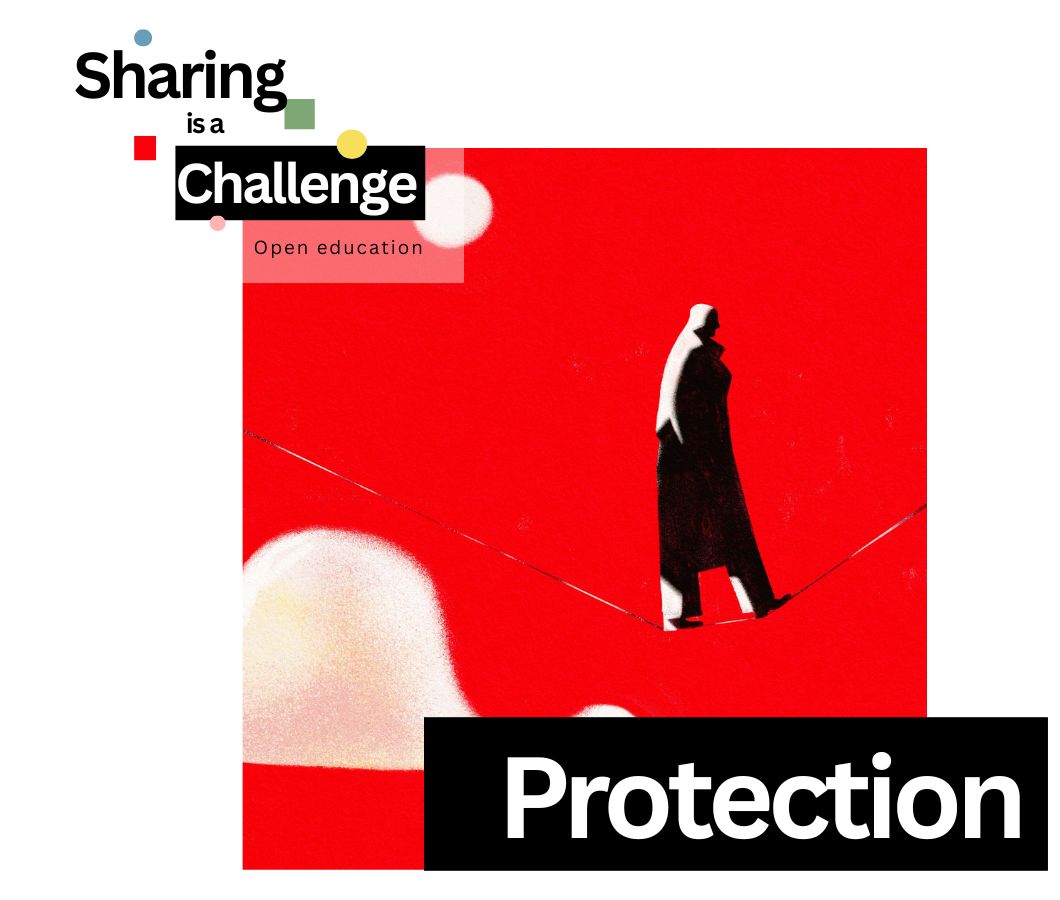
Featured image: “Walk In The Red Zone” by Lorenzo Miola for Fine Acts remixed by the UNESCO RELIA Chair licensed under CC-BY-NC-SA 4.0.
👤 Javiera Atenas. Javiera Atenas is a Senior Lecturer in the School of Business, Arts, Social Sciences and Technology at University of Suffolk, UK. She leads the postgraduate certificate in academic practice and teaches data analysis and visualisation for social scientists. Her research focuses on developing critical data literacies amongst academics and supporting institutions in developing open education, open data and science policies as well as building capacities in these areas. She has been working in HE in Europe, Latin America and the Middle East as a lecturer, researcher and policy advisor in openness to education, science and data. She is a member of the OER UNESCO dynamic coalition.
👤 Leo Havemann. Leo Havemann is a Programme Development Advisor at University College London with a background in digital education, teaching, library,and technology roles, and a doctoral researcher at the Open University. His research interests are in teaching and learning, learning design, and policies and practices in open and digital higher education.
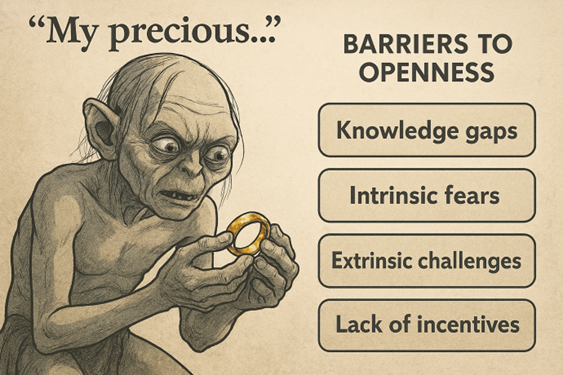
“My precious…” — Gollum, whispering to a ring. And, perhaps, academics whispering to their lecture slides.
We love to tell stories about openness: open access, open data, OER, open culture. We write about transparency and sharing as public goods, we publish articles evangelising openness — often in open access journals — and we celebrate it in policy documents, manifestos, declarations, recommendations and conference keynotes.
Yet when the conversation turns from theoretical openness to practical openness (“Would you mind sharing your teaching materials or data?”), many scholars suddenly clutch their pedagogical artefacts with Gollum-like intensity. The ring is safe, the slides and data stay hidden, and the VLE site remains a sealed vault.
This tension — openly publishing research while fiercely protecting teaching resources or data — is not simply hypocrisy. It is behavioural, cultural, structural, and deeply human.
Why the Reluctance? An Expedition Through the Barriers
1. The Knowledge Gap: Uncertainty Breeds Caution
Research shows that reluctance to engage with sharing resources openly often stems from a lack of information. Johnson (2018) portrays the academy as a landscape where academics hesitate, not because they’re opposed to openness, but because they are navigating myths, misconceptions, and incomplete guidance about IP and open practices; along the same lines many resist publishing open data because they do not fully understand its implications, benefits, or governance structures (Janssen et al., 2018).Uncertainty makes people risk-averse.
2. Skills, Confidence, Risk
As Creative Commons’ global consultation (2022) found, open culture hits barriers at the level of people: limited skills, insufficient training, fear of being judged, concerns about misuse, and plain old anxiety. Sharing teaching materials or data feels personal. These artefacts represent craft, not just content. Unlike research articles — which have been filtered through peer review, editing, and disciplinary conventions — teaching resources can feel incomplete, messy, localised, or idiosyncratic. Their development can be iterative over time and therefore, it is harder to define them as ‘finished’ and therefore ready for exposure to a wider peer audience, as opposed to the students in my classroom this year.
3. Intrinsic vs. Extrinsic Barriers
LeMire (2025) distinguishes between:
- Intrinsic barriers: lack of motivation, fears about quality, or perceptions that OER are inferior.
- Extrinsic barriers: workload, lack of institutional support, licensing confusion.
These map neatly onto faculty concerns: the internal “I’m not sure my materials are good enough” and the external “I don’t have the time, tools, or recognition to do this properly.”
4. Incentives
Value-based theory suggests that individuals embrace open practices when the perceived benefits outweigh the costs. Mandates for open access publishing have been relatively successful because:
- Compliance is required for funding.
- Reputation is enhanced by publishing openly.
- The benefits are clear and widely recognised.
But for teaching resources and datasets?
- Recognition is scarce.
- Labour is invisible.
- Risks feel personally consequential.
- Policies are inconsistent or absent across institutions.
In other words: researchers share what is rewarded, not what is merely encouraged.
Fix the Rewards, Not the People
Open scholarship/education is often framed as a cultural issue (“We must change attitudes!”), but behavioural research suggests that mandates, incentives, and infrastructures shape behaviour far more effectively than moral exhortations.
If academics feel that sharing teaching resources or datasets is done only for altruistic purposes, completely optional, or somewhat risky, they will likely continue treating them like Gollum’s ring — precious, and perhaps better protected from prying eyes.
To move beyond this paradox, both policy and practice must shift.
Policy Must:
- Reward openness in promotion criteria.
- Recognise creation and sharing of OER and open data as legitimate scholarship.
- Provide clarity and consistency on licensing, copyright, and reuse.
- Ensure that open data is supported with governance, infrastructure, and training.
- Foster communities and collaboration.
Practice Must:
- Model openness at departmental and institutional levels.
- Provide development and support for academics in open pedagogy, open science, open licences, and data publishing.
- Foster communities of sharing so that openness becomes habitual, not exceptional.
- Celebrate contributions — not only citations but teaching artefacts, datasets, and learning designs.
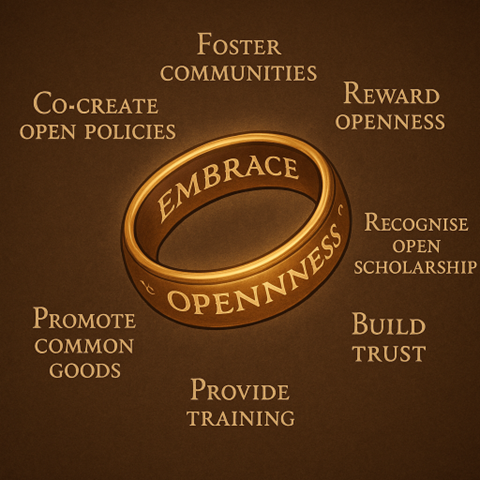
Open scholarship is not merely a technical exercise; it is a social one. It is vital to recognise the role of communities and collaboration in supporting these practices (Havemann et al., 2023). Behavioural reluctance is understandable, given the risks, norms, and incentive structures in place. But the potential benefits — transparency, equity, innovation, and collective growth — are too significant to leave buried in personal drives and institutional servers.
To unlock academic “preciouses” for the common good, we must change the environment, not just the mindset. And maybe help academics see that sharing their resources does not mean losing them, but multiplying their impact.
References
Creative Commons. (2022, July 22). What are the barriers to open culture? Here’s what the CC community has to say. https://creativecommons.org/2022/07/22/what-are-the-barriers-to-open-culture-heres-what-the-cc-community-has-to-say/
Havemann, L., Corti, P., Atenas, J., Nerantzi, C. and Martinez-Arboleda, A. (2023). Making the case: opening education through collaboration. Rivista di Digital Politics, 3(2) pp. 305–326. https://doi.org/10.53227/108468
Janssen, M., Charalabidis, Y., & Zuiderwijk, A. (2012). Benefits, adoption barriers and myths of open data and open government. Information Systems Management, 29(4), 258–268. https://doi.org/10.1080/10580530.2012.716740
Johnson, G. J. (2018). Cultural, ideological and practical barriers to open access adoption within the UK academy: An ethnographically framed examination. Insights: The UKSG Journal, 31(0), 22. https://doi.org/10.1629/uksg.400
LeMire, S. (2025). Faculty barriers to using open educational resources. Open Learning: The Journal of Open, Distance and e-Learning, 1–19. https://doi.org/10.1080/02680513.2025.2573338
✍ The series of articles. This article is part of the series “Sharing is a challenge”, published throughout March 2026, in collaboration with the UNESCO RELIA Chair and the UNITWIN-UNOE network.
📧 Newsletter. To receive the upcoming articles from this series by mail, subscribe to our newsletter.
🖼️ Featured image. The original artistic intent remains that of the artist and may differ from the editorial intent of our remix. We thank Lorenzo Miola for sharing their work on Fine Acts under the open licence CC BY-NC-SA 4.0.
🅭🅯 Licence and reuse. Unless otherwise indicated, the content of this article is licensed under CC BY 4.0.