

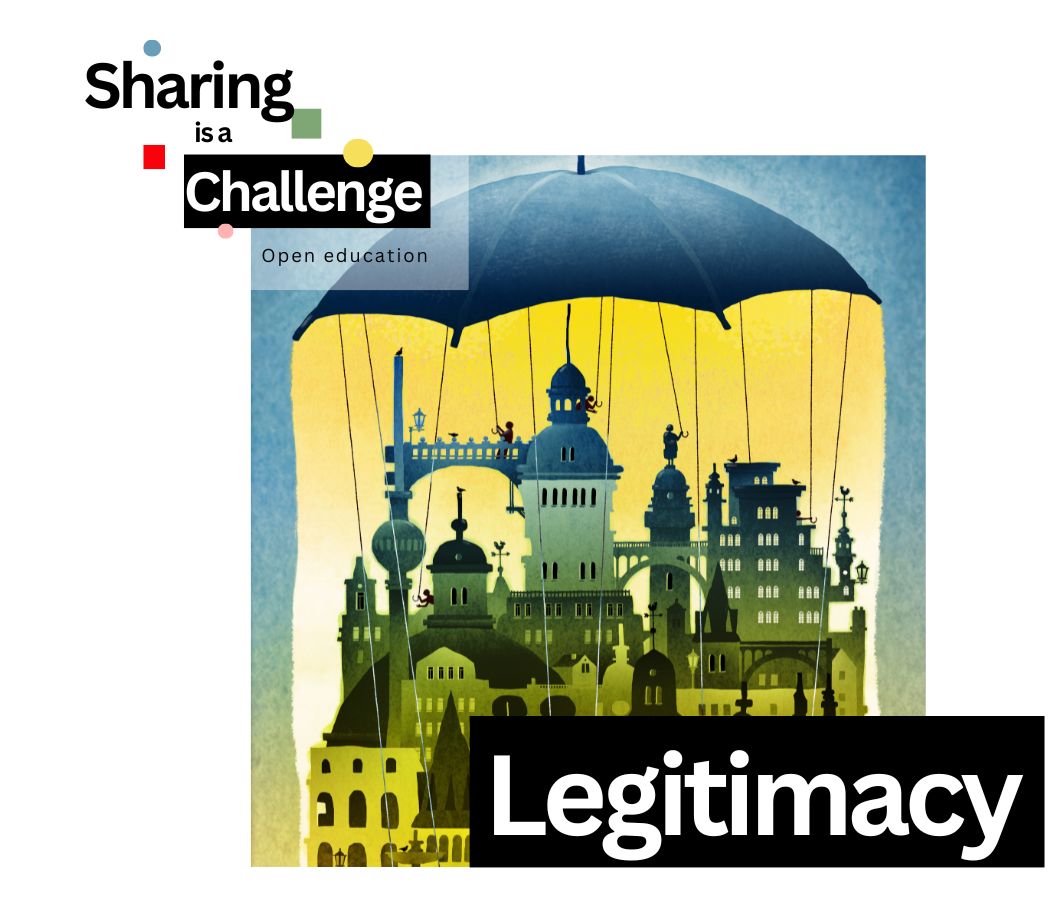
Featured image: “Our umbrella” by Luka Seme for Fine Arts remixed by the UNESCO RELIA Chair licensed under CC-BY-NC-SA 4.0.
👤 Marcela Morales. Marcela Morales is Co-Executive Director of Open Education Global, with over 15 years of experience advancing open education worldwide. She works to expand equitable access to knowledge, foster global collaboration, and support open practices through partnerships with institutions, governments, and civil society organizations.
When sharing feels reserved for an elite few
One of the most persistent, yet least visible, hurdles in open education is legitimacy. It is not about technology, licensing, or institutional policy. It is about an internalized belief that whispers, sometimes quite loudly:
“Sharing is only worthwhile for an elite few. What is the point of sharing my lesson or lesson plan when I am not at a prestigious institution? I am not at that level.”
This feeling is widespread across educational contexts around the world, spanning formal and informal settings, well-resourced and resource-constrained institutions, and systems with very different histories, missions, and expectations. Educators may be deeply committed to their learners and highly skilled in their practice, yet still doubt whether their materials are “good enough” to be shared openly.
Legitimacy, in this sense, is socially constructed. Prestige, rankings, institutional branding, and publication cultures strongly influence whose knowledge is seen as valuable. Open education, despite its inclusive ideals, does not exist outside these dynamics. Repositories, conferences, and citation practices can unintentionally reinforce hierarchies by amplifying voices that are already widely recognized and validated.
The result is a quiet but powerful form of self-censorship. Educators hold back not because they lack expertise, but because they fear judgment about their context, their approach, their institutional standing, or whether their contributions will be seen as legitimate or relevant at all. These doubts are not abstract; they are heard repeatedly in open education spaces:
- My materials are too basic to be worth sharing.
- My teaching context will be dismissed as less rigorous or less relevant.
- What I do is too local and specific to matter beyond my setting.
- I don’t have the right language, framing, or institutional standing to contribute.
This hesitation is not trivial. When only those who already feel legitimate choose to share, the open education ecosystem becomes narrower, less diverse, and increasingly shaped by a limited set of voices and experiences. The result is an incomplete picture of teaching and learning—one that overrepresents well-resourced environments and underrepresents the everyday realities in which most education actually takes place. Learners and educators alike lose access to materials grounded in local contexts, constrained resources, multilingual classrooms, culturally situated knowledge, and pedagogical traditions developed in response to real-world limitations.
Ironically, these are often the very contexts where open educational resources are most urgently needed and where they can have the greatest impact. When these perspectives remain absent, openness risks reproducing the same inequities it seeks to address, rather than serving as a tool for widening participation, relevance, and collective learning.

Reframing legitimacy: from prestige to practice
If legitimacy is a hurdle, it is also one that can be dismantled, collectively and intentionally.
- Redefine what counts as expertise
Open education must move beyond equating legitimacy with institutional prestige. Expertise is not produced only in elite institutions; it is built through sustained practice, iteration, and close responsiveness to learners. A lesson refined over years in a teaching-focused institution, a rural school, or an online program carries a different, but equally valuable, kind of knowledge.
Sharing is not a claim to perfection. It is an invitation to learn from lived pedagogical experience. Describing resources as “adaptable,” “context-specific,” or “tested in a particular setting” helps shift expectations away from universal models and toward contributions meant to be reused, questioned, and reshaped by others.
- Normalize “unfinished” sharing
One powerful way to lower the legitimacy barrier is to normalize the sharing of materials that are not polished, final, or comprehensive. Drafts, activity outlines, assessment prompts, and reflective teaching notes often carry as much practical value as fully developed resources, particularly for educators seeking ideas they can adapt rather than replicate.
Open education does not demand completeness or perfection; it depends on reuse, revision, and contextual adaptation. Making this explicit in workshops, repositories, and calls for contributions helps shift expectations and signals that contributing is an act of participation and collective learning, not a performance to be evaluated.
- Make context visible, not invisible
Educators often worry that their institutional or teaching context will be perceived as a weakness rather than a strength. Instead, context should be understood as essential metadata, not as a liability to be concealed. Clearly describing who a resource was designed for, under what conditions, and with which pedagogical assumptions increases both its usefulness and its credibility for others.
A lesson developed for first-generation learners, multilingual classrooms, or low-bandwidth environments carries a form of legitimacy grounded in honesty and relevance. Context does not diminish a resource’s value; it makes that value visible.
- Build relational, not reputational, recognition
Legitimacy is built through relationships, not reputation alone. Communities of practice, peer feedback spaces, and regional or thematic networks play a critical role in helping educators feel seen, supported, and confident in their contributions. When sharing takes place within trusted communities, confidence grows over time, and the step toward more visible, public sharing becomes far less intimidating.
Recognition practices in open education should therefore prioritize contribution, care, and collaboration, rather than focusing narrowly on visibility or quantitative metrics. Simple actions such as acknowledging adaptations, thanking contributors, or intentionally amplifying diverse voices can have a lasting and meaningful impact.
- Name the problem explicitly
Finally, legitimacy must be talked about openly. Naming this hurdle helps educators recognize that they are not alone, and that their doubts are not personal shortcomings but the product of broader structural and cultural dynamics. Workshops, training sessions, and open education initiatives should explicitly surface issues such as impostor feelings and prestige bias as part of meaningful capacity building.
When legitimacy is understood as a shared, systemic challenge rather than an individual deficit, it becomes easier to acknowledge, discuss, and gradually address together.
Sharing as an act of belonging
At its core, open education is not only about access to resources; it is about belonging to a shared knowledge commons. Sharing becomes an act of presence and recognition, a way of saying: my experience matters, my context matters, and I belong to this collective effort.
Legitimacy does not always precede sharing; it often emerges through the act of sharing itself. Each contribution, however small it may feel, expands what open education can be like and who it is for.
Clearing the hurdle of legitimacy means recognizing that open education is weakened when only a few feel entitled to speak and strengthened as more people come to realize they already have something worth sharing.
✍ The series of articles. This article is part of the series “Sharing is a challenge`”, published throughout March 2026, in collaboration with the UNESCO RELIA Chair and the UNITWIN-UNOE network.
📧 Newsletter. To receive the upcoming articles from this series by mail, subscribe to our newsletter.
🖼️ Featured image. The original artistic intent remains that of the artist and may differ from the editorial intent of our remix. We thank Luka Seme for sharing their work on Fine Arts under the open licence CC BY-NC-SA 4.0.
🅭🅯 Licence and reuse. Unless otherwise indicated, the content of this article is licensed under CC BY 4.0.