

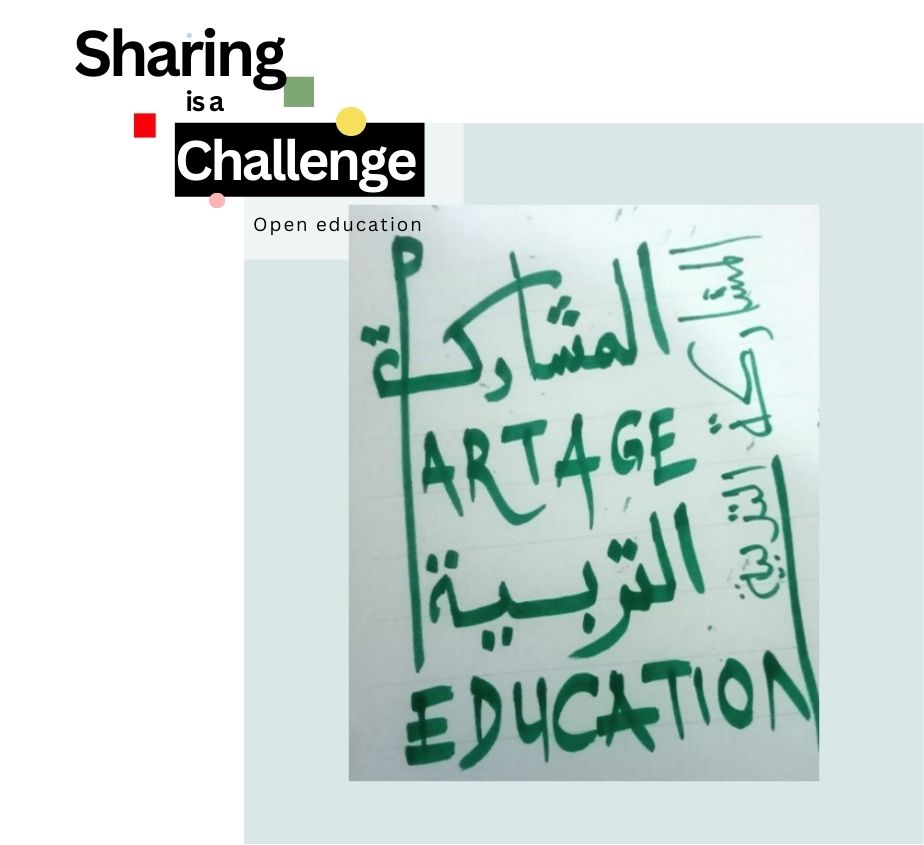
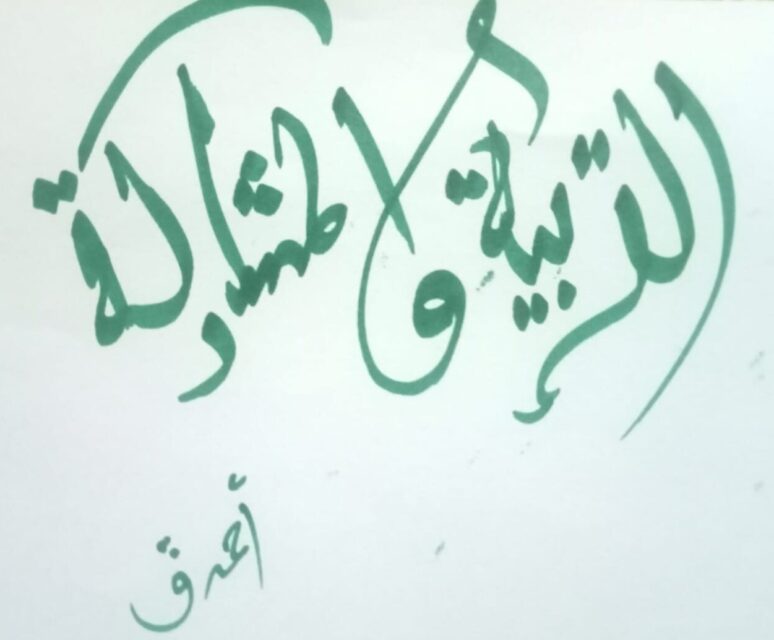
Featured image: “Composition of several words in Arabic and French: sharing, education“ by Ahmed Galai (2026) for ” Sharing is a challenge” remixed by the UNESCO RELIA Chair.
👤 Ahmed Galai. Human and peoples’ rights activist. Member of the steering committee of the Tunisian Human Rights League from 2000 to 2016 (2015 Nobel Peace Prize winner with the National Dialogue Quartet). Member of the scientific council of the Arab Institute for Human Rights and the national commission for the reform of the Tunisian education system. Former general advisor on school and university information and guidance.
Speaking of sharing, we can easily parody the adage of the Palo Alto School: “We cannot not communicate,“ as communication and sharing are concomitant concepts. Indeed, “we cannot not share“.
Sharing is a fundamental social value rooted in interpersonal and social customs since the formation of the first human societies. Potlatch, for example, is a very ancient practice analysed by anthropologist Marcel Mauss (The Gift). This form of ritual gift-giving shows how the indigenous peoples of present-day Canada and Alaska gave and received goods, food or blankets during their social or religious festivities, thus marking their status or prestige and cementing recognised hierarchical social relationships.
Whether through barter or other means, exchanges not only satisfied material consumption needs, but also feelings, ideas and meaning, allowing each person to assert their individuality and specific contribution. Moreover, Al-Jâhiz, an Arab encyclopaedist of the 8th century AD, understood this well when he wrote, “Ideas are scattered on the roads, but it is through words that people distinguish themselves…” (إن المعاني ملقاة على قوارع الطريق، وإنما يتميز الناس بالألفاظ). This 8th-century thinker argued that ideas are not locked away in the mind of a scholar, but are a common good accessible to all who wish to use, understand and pass them on. Ideas circulate freely, and it is up to each of us to demonstrate our creative uniqueness based on what we have in common. It is from this circulation that the universal heritage of human knowledge is born and progresses. The Road of Sharing that AL-Jahiz speaks of is this rich and colourful living space asserted by our travels, our debates, our diverse languages and cultures. Did Descartes not say: “Common sense is the most evenly distributed thing in the world”?
This is how our intelligence multiplies when we share it without any desire to confiscate it: we learn to open ourselves to otherness and build our world together.
It is obvious that schools, the ultimate space for socialisation, will draw on this rich soil of sharing. For Durkheim, “Education is the action exerted by adult generations on those who are not yet mature for social life. “ (Education and Sociology, 1922). This intergenerational transmission is not a simple mechanical transfer. Rather, it is a thoughtful act through which adults prepare the conditions for the social sharing of values and knowledge.
Education thus appears as an ethic of transmission and sharing, essential for building the future, especially in today’s world marked by inequality, social tensions and widespread competition.
Sharing education means recognising above all that knowledge is a common good that must be distributed democratically and equitably without any discrimination, in accordance with a human rights-based approach. To ensure that education is a factor of emancipation and not of domination and “reproduction of inequalities” (Bourdieu), we must ensure accessibility for all by sharing curricula, opening schools to their environment, promoting peer learning, supporting open educational resources and recognising the diversity of forms of knowledge and multiple intelligences (Gardner). This logic of sharing helps to reduce social divisions and strengthen educational justice.
Operating on the basis of sharing, schools must also educate children to share in order to correct the biases of competition and the relentless pursuit of performance. Because the values of sharing can be learned. At school, this involves cooperative teaching methods, collective projects, group work, debate and mutual assistance. Educating children to share means teaching them to give and receive, to listen to others and to recognise that we progress better together than alone. These lessons develop life skills such as empathy, solidarity and responsibility.
By promoting sharing, education combats the logic of individualism and encourages us to think of success not as something achieved against others, but with others. It prepares citizens for dialogue, solidarity and peaceful conflict resolution so that together we can build a more just, inclusive, united and peaceful society.
✍ The series of articles. This article is part of the series “Sharing is a challenge”, published throughout March 2026, in collaboration with the UNESCO RELIA Chair and the UNITWIN-UNOE network.
📧 Newsletter. To receive the upcoming articles from this series by mail, subscribe to our newsletter.
🌐 Translation. This article has been written in French. This translation, produced using automatic tools and then proofread by our team, may contain inaccuracies. Please report any errors to us.
🅭🅯 Licence and reuse. Unless otherwise indicated, the content of this article is published under the CC BY 4.0 license.